

Why Every Hair Loss Product You've Tried Has Secretly Failed You.
You already know the routine.
You catch yourself in the bathroom mirror at a bad angle and your stomach tightens. You count the strands that come out when you run your fingers through your hair. You take pictures of your crown from above and try to convince yourself nothing's changed.
It has. And the worst part is that you've probably already tried to do something about it. A serum. A foam. A pill your doctor pushed on you. You gave it months. And you watched, in that same mirror, as it made no real difference.
You're not imagining it. And it's not your fault.
Here's what your dermatologist almost certainly didn't tell you:
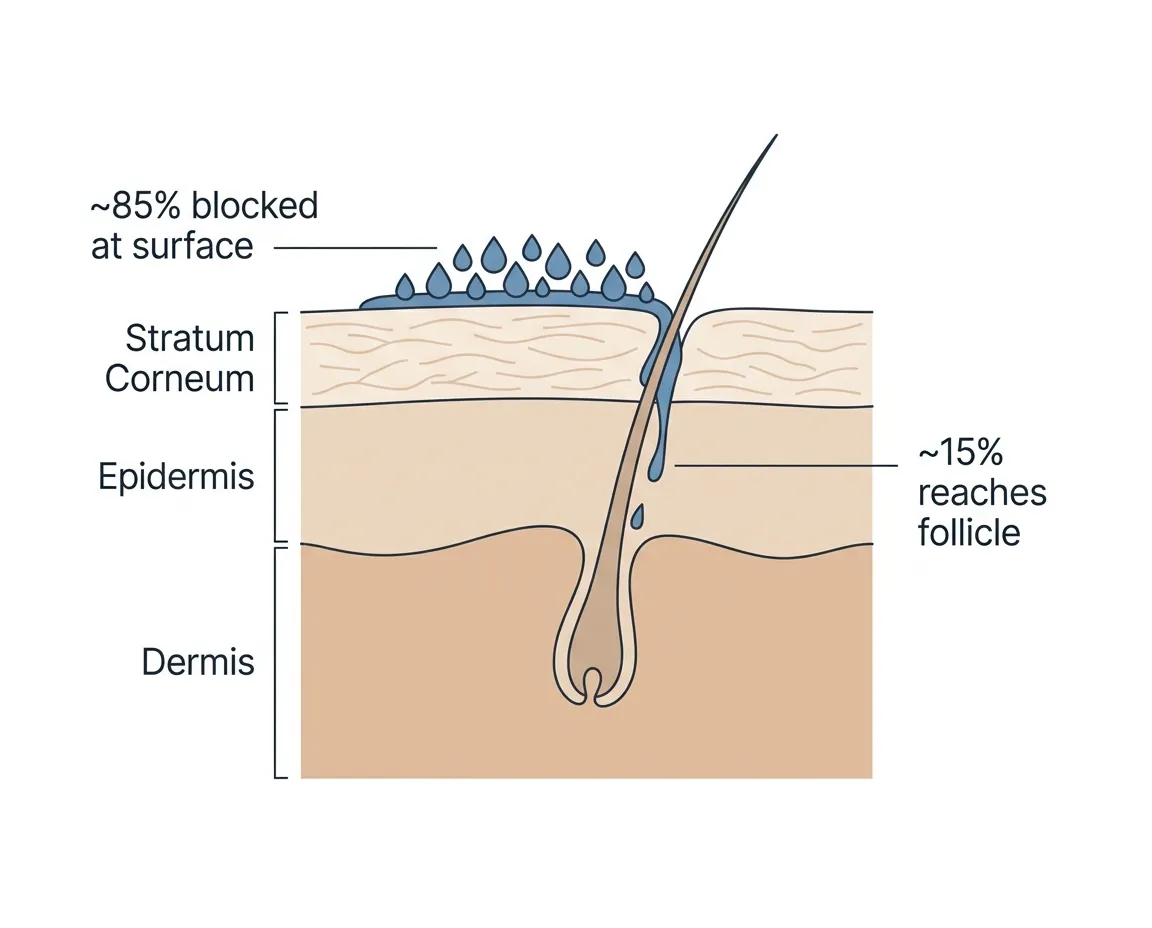
Up to 85% of every hair loss product ever invented never reaches the part of your scalp that actually matters.
Not because the ingredients are bad. Because the delivery is broken.
This is the story of why everything you've tried has failed — and what finally works.
Up to 85% of every topical hair loss product never reaches the follicle. Most of what you paid for is sitting on your skin, evaporating.
PROBLEM 01
Why Topical Serums & Minoxidil Don't Work
For 30 years, men have been buying serums that sit on the skin and evaporate. Foams that wash down the drain. Shampoos that were never going to work no matter how long they used them. And when those failed — as they were mathematically guaranteed to fail — the industry's answer was always to sell you the next thing.
Let's start with the one your dermatologist probably pushed first: minoxidil.
It's the active ingredient in Rogaine. It's the "foam" in nearly every over-the-counter hair product in America. It's what every barber and every forum tells you to try before you give up.
And it has the same fatal flaw as every topical that came before it: your skin is designed to keep it out.
The outer layer of your scalp — the stratum corneum — is a biological firewall. Its job is to stop foreign substances from getting into your body. It can't tell the difference between a hair serum and a toxin. It blocks both.
So here's what actually happens every time you apply a topical:
- ~85% of the active ingredient never reaches the follicle
- What gets through is metabolized before it can do meaningful work
- Twice-daily application becomes mandatory just to maintain surface concentration
- Miss a few days → any progress resets
This is why minoxidil users wait 6 to 12 months for results that show up as thin, wispy "peach fuzz" — hair that looks worse in certain lighting than nothing at all. It's why if you miss two days of application, you start losing hair again within a week. And it's why the moment you stop, every gain you made falls out.
The formulation was never the problem. The delivery was.
PROBLEM 02
Why Finasteride Is The Wrong Tool For The Job
When topicals fail, the industry's next move is to hand you a prescription pad.
Finasteride does technically work. I'm not going to pretend otherwise. But understanding how it works should make any man stop and think hard before filling that prescription.
Finasteride shuts down DHT — the hormone responsible for pattern hair loss — across your entire body. Not just your scalp. Everywhere. To save the follicles on your head, it rewires the hormonal system that also governs your libido, your mood, your mental clarity, and your sex drive.
That's the equivalent of burning down your house to kill a wasp in the attic.
The clinical literature on the side effects is well-documented:
- Reported erectile dysfunction in a meaningful minority of users
- Decreased libido
- Brain fog, mood changes
- "Post-Finasteride Syndrome" — symptoms that can persist after cessation
And the part nobody mentions at the pharmacy counter: the moment you stop taking it, every hair you "saved" falls out within months. Fifteen years of pills. Lifetime of pills. Or you accept going bald anyway.
The real problem is DHT at the scalp. Finasteride's answer is to eliminate DHT everywhere. That's not an ingredient problem. That's a targeting problem.
PROBLEM 03
Why Hair Transplants Are Rarely The Answer
When the pills fail — or a man is smart enough to refuse them — the industry's final answer is surgery.
A hair transplant at a reputable clinic costs $8,000 to $15,000 per session. Most men need two sessions. Overseas clinics are cheaper and ethically complicated, with far higher rates of botched results, infections, and "corridor harvesting" that ruins the donor area for life.
What the glossy consultation brochure won't tell you:
- You'll likely still need finasteride afterward to protect the native hair you have left
- Results depend heavily on donor density — many candidates aren't good candidates
- Recovery involves visible scabbing, shock shedding, and months of unflattering interim appearance
- It's surgical. There's no reversing it.
Transplants are a legitimate option for a specific subset of patients. For everyone else, they are a $24,000 way to end up exactly where you started — back on finasteride, to protect what's left. You didn't solve hair loss. You just bought four months of scabbing for the privilege of still needing the pill.
THE BREAKTHROUGH
What Actually Solves The Delivery Problem
So here's the part of the story that changes everything.
The breakthrough isn't a new ingredient. The hair loss industry has had the right ingredients for decades. The breakthrough is finally solving the problem that made every one of those ingredients useless.
The breakthrough is delivery.
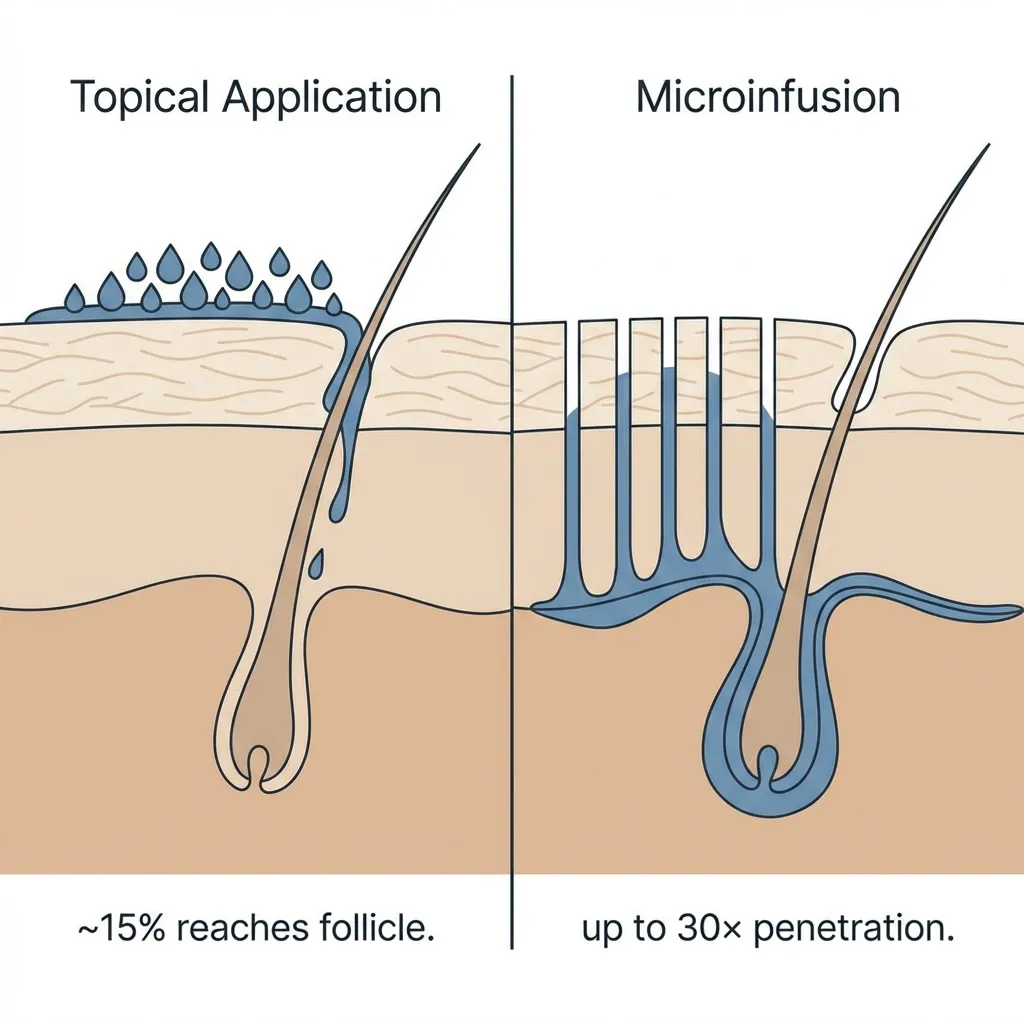
It's called microinfusion. It uses medical-grade 0.5mm needles to create microscopic channels through the stratum corneum — the same biological firewall that blocks 85% of every topical ever made. The channels stay open for a few minutes, long enough for a peptide serum applied immediately after to bypass the firewall completely and reach the follicle directly.
The clinical difference isn't subtle:
- Topical application: ~15% of actives reach the follicle
- Microinfusion application: up to 30x greater penetration in controlled measurements
This isn't a theory. It's the same mechanism behind microneedling for collagen — a procedure that's been a dermatology staple for fifteen years. We're just applying the same physics to hair: instead of driving hyaluronic acid into the skin to build collagen, we drive copper peptides and growth-phase modulators into the follicle to reactivate hair.
It's why results show up in 2 to 4 weeks — not 6 to 12 months.
It's why you use it 3 times a week, 5 minutes per session — instead of twice-daily forever.
It's why missing a few days doesn't erase your progress. The follicle has been reactivated, not propped up.
And it's why, for the first time in 30 years, men who had given up on their hair have a real reason to try one more thing.
THE FORMULA
The Peptide Stack That Actually Does The Work
Delivery without the right payload is just expensive poking. The channels are the breakthrough — but what goes through them is what regrows your hair. Here's the exact formula the American Biolabs Microinfusion System delivers through those microchannels, direct to the follicle:
| Active | Function | Research |
|---|---|---|
| GHK-Cu Copper Peptides | Follicle reactivation | Multiple peer-reviewed studies |
| Adenosine | Extends the anagen (growth) phase | Clinical trials in male pattern hair loss |
| Procyanidin B2 | Increases hair thickness + density | Published dermatology research |
| Biochanin A | DHT defense — at the scalp only, not systemic | Isoflavone research |
| Caffeine | Stimulates follicle metabolism | Topical application studies |
| Plant-Derived Exosomes | Enhanced cellular delivery | Emerging peptide research |
| Biotin + Zinc | Keratin building blocks | Established nutritional science |
Every active on this list has published research. No "proprietary blends." No mystery ingredients. No ancient-secret marketing.
And the formula is blue — visibly, unmistakably blue — because real GHK-Cu at a therapeutic dose is blue. It's the copper ion. If a serum that claims copper peptides is clear or white, the concentration is too low to matter. You can tell the fakes by looking at them.
Ready to try the first thing that actually reaches your hair?
American Biolabs Microinfusion System
Starting at $25.90/month
TRY IT RISK-FREE →- 7 clinically-studied peptide actives
- Zero hormonal side effects
- Results in 2–4 weeks
THE PROOF
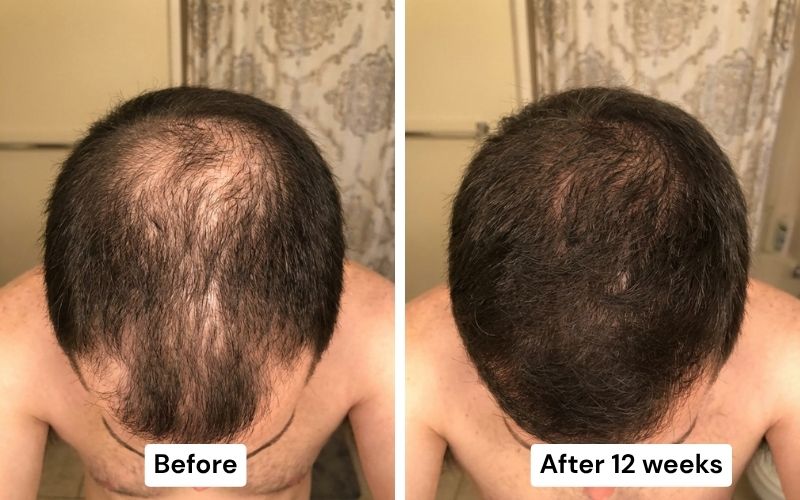
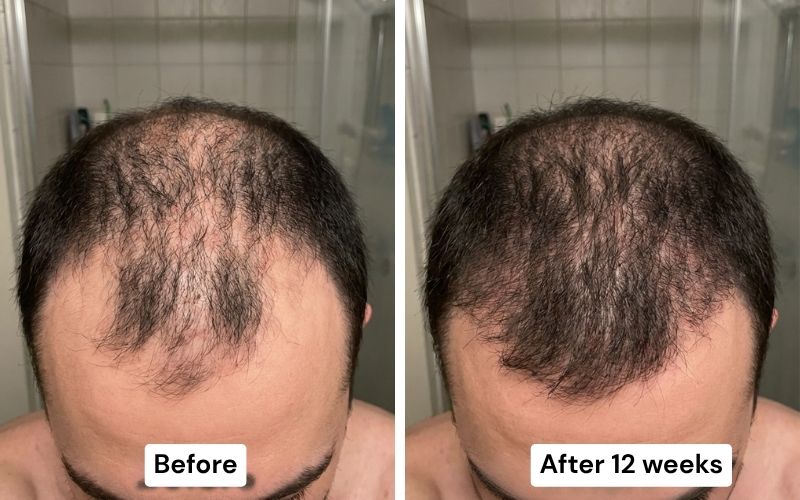
What 90 Days Of Actual Delivery Looks Like
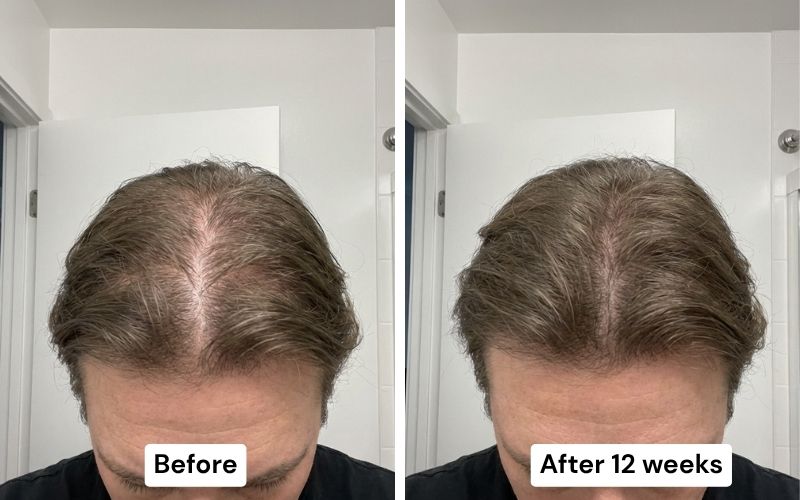
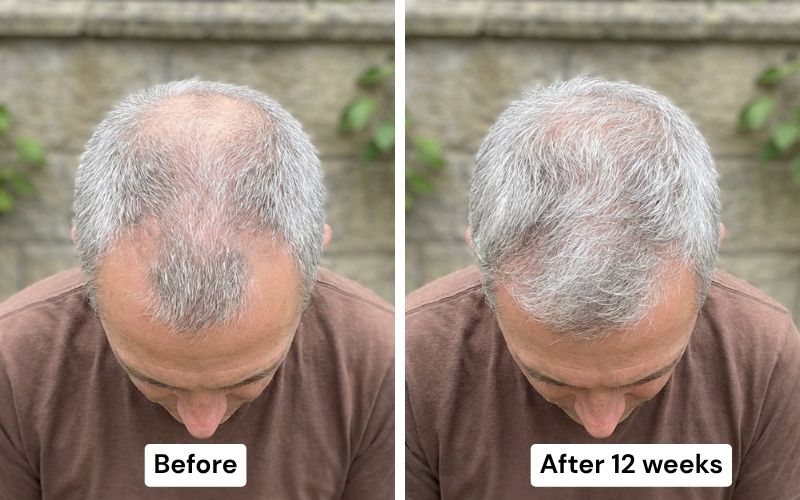
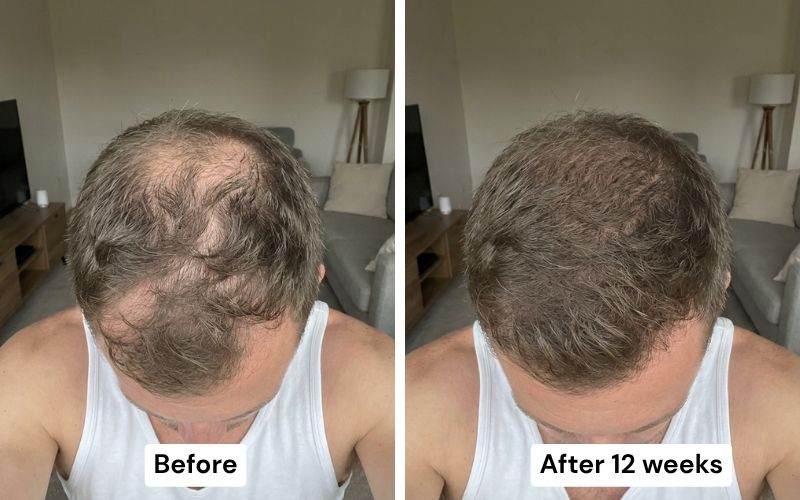
WHAT MEN WHO STOPPED FIGHTING TOPICALS ARE SAYING
"Shedding stopped at week 2. By week 8 my girlfriend noticed without me saying a word. This actually works"
David M., 34 · VERIFIED BUYER
"I quit finasteride 6 months ago and switched to this. My hair AND my sex life are back."
Carlos A., 38 · VERIFIED BUYER
"My barber asked me if I'd been to Turkey. Showed him the device on my phone. He didn't believe me at first."
Matt R., 31 · VERIFIED BUYER
"I was researching transplants when I found this. Glad I read more before booking."
Jason K., 29 · VERIFIED BUYER
THE OFFER
Choose Your Plan
The American Biolabs Microinfusion System is available in three plans. Most men start on the 6-month plan — it's how long clinical results typically stabilize, and it's the lowest price per month.
1 Month
$49/month
Device + 1-month peptide serum supply
6 MonthS
$25.90/month
Device + 6-month supply
Save $139 + Free Shipping
3 MonthS
$32.90/month
Device + 3-month supply
Save $48
- 120-Day Money-Back Guarantee
- Free priority shipping on the 6-month plan
- Free sterile replacement heads
- Subscribe & save 20%
QUESTIONS MEN ASK BEFORE THEY START
Your Questions, Answered
Yes. Microinfusion works on a different mechanism than any of those. In fact, many of our longest-running users came to us after one or more of those options failed or caused side effects.
No. The 0.5mm medical-grade needles create channels through only the outermost skin layer. Most users describe the sensation as light tapping — similar to a stiff-bristle hairbrush pressed against the scalp.
Shedding typically stops in the first 2 weeks. Visible new growth at week 4–6. The full transformation most men are looking for shows up between weeks 10 and 16.
Yes — though results vary by starting point. Men with dormant follicles (recent or moderate thinning) tend to see the most dramatic regrowth. Men with fully miniaturized follicles in certain zones may see partial results. The 180-day guarantee is there specifically to let you find out risk-free.
The peptides work topically at the scalp only — they do not enter the bloodstream at meaningful concentrations. There are no reported hormonal side effects associated with the stack.
Return it within 180 days for a full refund — no restocking fees, no questionnaires, no counter-offers. Keep the device.
You've Read The Science. Now Try It For Yourself.
American Biolabs Microinfusion System
Starting at $25.90/month on the 6-month plan
- 120-Day Money-Back Guarantee
- Free Shipping
- Zero Drugs, Zero Hormonal Side Effects
- Trusted by 147,000+ men